
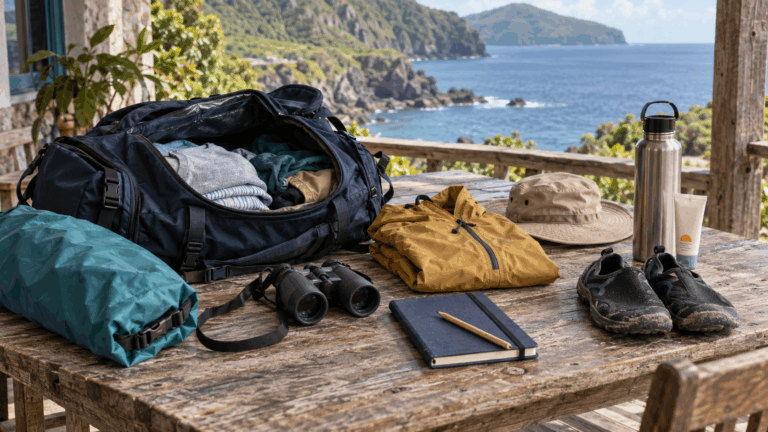
Packing for a marine biology internship requires a different mindset from packing for a holiday or even for a standard university field trip. You are preparing for an extended period of physical outdoor work, often on or in the water, in conditions that are harder on clothing and equipment than everyday life. The wrong choices cost you comfort and functionality. The right ones are easy to overlook until you are already there.
This guide covers everything from fieldwork clothing and boat-day essentials to diving equipment, documents, technology, and the items that are almost never worth bringing. Read it alongside the specific guidance from your host organisation, because that information takes precedence over any general list.
Check your unternship requirements before packing
Before you start buying anything or pulling out a suitcase, contact your host organisation and ask explicitly what they provide. This single step prevents most packing mistakes.
The equipment available to interns varies considerably between programmes. Some provide full scuba equipment including wetsuits, BCDs, regulators, tanks, and weights. Others expect interns to bring their own mask and fins at minimum. Some supply field clothing or a programme uniform. Some provide accommodation with linen; others do not. Some have a well-stocked first-aid kit on site; others expect each intern to bring their own basics. Scientific equipment, slates, datasheets and identification guides are often provided, but not always.
Assuming that something is included without confirming it can leave you short of essentials. Confirming it can save you carrying, and paying for, things you do not need.
The specifics of your destination also shape your packing significantly. A four-week programme in the Canary Islands has different clothing requirements from a programme in northern Scotland or the Caribbean. Day length, water temperature, sun intensity, access to shops and laundry, and the nature of the fieldwork itself all affect what you actually need. Use the destination and programme description as the starting point, and the list below as a framework to build from.
Essential clothing for marine fieldwork
Marine fieldwork clothing needs to be functional above everything else. Quick-drying fabrics, durability, and practicality matter far more than appearance. You will wear these items hard, wash them frequently, and expose them to saltwater, sun, and physical work. Pack accordingly.
Lightweight, quick-drying clothing. Synthetic fabrics, merino wool blends, and technical outdoor materials dry rapidly and resist the smell retention that cotton is prone to after repeated saltwater exposure. Bring enough for the duration of the programme, accounting for washing cycles rather than a complete change for every day.
Waterproof jacket. Even in warm destinations, a lightweight waterproof is essential for boat travel, early morning fieldwork, and unexpected weather changes. It does not need to be a heavy expedition jacket. A packable, windproof waterproof that can be stuffed into a dry bag is usually sufficient and far more practical.
Warm layer for early mornings and time at sea. This surprises most people preparing for warm-climate programmes. Early morning boat departures, extended time on the water, and post-dive conditions can feel significantly colder than the ambient temperature suggests. A thin fleece or thermal layer takes up almost no space and removes a significant source of discomfort.
Swimwear. Bring two or three sets so that one is always dry. Saltwater and repeated use degrade swimwear relatively quickly, so if your current swimwear is already worn, it is worth replacing it before you leave.
Comfortable clothes for data work and downtime. Not all fieldwork happens in the water. Data entry, equipment cleaning, report writing and team briefings take place on land. A few sets of casual, comfortable clothes that you are not worried about getting dirty are worth including.
Hat with a brim. Full brim or wide brim rather than a cap, if possible. Extended time on boats and in open environments means sun exposure to the face, neck, and ears that a standard cap does not cover. A hat that stays on in wind is better than one that does not.
Polarised sunglasses. The reflective glare off open water is significant and fatiguing over a full field day. Polarised lenses reduce it substantially and make spotting surface activity and underwater features considerably easier. This is not a vanity item.
Closed, non-slip footwear. Boat decks, rocky shores, and wet surfaces require footwear with a grip. Trainers or hiking shoes that you do not mind getting wet are a reasonable choice. Purpose-made water shoes with a sole that grips on wet surfaces are even better and generally lighter.
Sandals or water shoes for general wear. Separate footwear for non-fieldwork hours is worth having so that your main shoes can dry between uses.
What to pack for boat-based fieldwork
Days spent on a research vessel or small boat have specific requirements that differ from general outdoor fieldwork. The sun is more intense on open water, dehydration happens faster, and conditions are harder on both people and equipment than they appear from the shore.
Reusable water bottle, large capacity. Hydration on boat days requires more active management than on land. A one-litre or larger insulated bottle keeps water cool and reduces the temptation to rely on single-use plastic. Many programmes actively discourage single-use plastics for environmental reasons, so a reusable bottle is both practical and appropriate.
High-protection sunscreen, reef-safe. Sun protection factor 50 or above, applied generously and reapplied every two hours on sun-exposed days. Reef-safe formulations, meaning those free from oxybenzone and octinoxate, are required near coral reef environments and strongly preferred in all marine conservation contexts. Bring more than you think you will need.
Polarised sunglasses. Listed here again because they are genuinely important on boat days and often forgotten until the first day on the water makes the oversight obvious.
Waterproof dry bag. A 10 to 20-litre dry bag protects documents, phones, cameras, and other non-waterproof items during boat travel, water entry, and unpredictable spray. It is one of the highest-utility items on this list relative to its cost and weight.
Seasickness medication. If you know you are prone to motion sickness, bring your usual remedy and do not wait to see whether the boat conditions trigger it. If you are unsure, bring medication anyway. Some people find they are affected by smaller vessels in choppier water even if they have never been seasick before. Prevention is considerably more comfortable than managing the alternative mid-research-day.
Small quick-dry towel. A microfibre towel takes up a fraction of the space of a standard towel, dries in minutes, and is sufficient for post-dive or post-snorkel situations on the water.
Waterproof phone case or pouch. Separate from your dry bag, a phone-specific waterproof case allows you to access your phone for photography, notes, or communication on the water without removing it from protection. A lanyard attachment prevents it going overboard.
Notebook and pencils. Pencils, not pens. Pencils write on wet paper; pens do not. A waterproof or water-resistant notebook is worth the small additional cost. Even if the programme provides datasheets, having a personal notebook for observations and questions is useful.
Diving and snorkelling equipment
What diving and snorkelling equipment you need to bring depends almost entirely on what your programme provides. Confirm this in writing before making any purchasing decisions.
Equipment usually provided by the programme
Most established marine biology internship programmes that involve scuba diving provide the major equipment: wetsuit, buoyancy control device (BCD), regulator, tank, and weights. Providing these items is partly logistical — they are heavy and difficult to travel with — and partly safety-related, since equipment used in a research context should be serviced and maintained to a known standard.
Do not assume this is the case without confirming it. And if the programme does provide equipment, confirm that the wetsuit sizes available will fit you, so that alternatives can be arranged if necessary before you arrive.
Personal equipment worth bringing
Regardless of what the programme provides, the following are generally worth bringing yourself.
Your own mask. Fit matters more for masks than for any other piece of dive equipment. A mask that fits your face correctly is more comfortable, seals better, and performs better than a communal mask that may or may not suit your features. If you dive regularly, use your own mask. If you are newer to diving, visit a dive shop before departure to be fitted properly.
Fins. If you have your own fins that fit your feet well, bring them. If not, confirm that the programme provides them in your size. Open-heel fins with bootie socks allow more precise sizing adjustment than full-foot fins.
Neoprene socks or booties. Even in warm-water destinations, booties prevent blisters from fins and provide thermal protection during extended dives. They are lightweight and take up minimal space.
Swimwear worn under the wetsuit. Bring swimwear that works as a wetsuit undergarment. A one-piece or close-fitting suit is more comfortable under a wetsuit than loose-fitting shorts.
Quick-dry towel. Already listed above, but particularly useful post-dive.
Any accessories specifically approved by your host organisation. If you use an underwater camera, computer, or other personal dive accessories, confirm with the programme that bringing them is appropriate and that they will not create logistical complications in the field.
Never bring personal diving equipment that has not been serviced recently or that you are not fully familiar with. Field environments are not the right place to encounter equipment problems for the first time.
Technology and study materials
Laptop and charger. For data entry, report writing, species research, and staying in contact with your university programme coordinator if required. Confirm in advance whether your accommodation has reliable power access, and pack a surge protector if you are travelling to a destination where power fluctuations are common.
Phone and power bank. A fully charged power bank with enough capacity for a full day of use is valuable on long boat days where charging opportunities may not exist. Your phone is also likely your primary camera for much of the programme.
Universal travel adapter. European students travelling to Atlantic island destinations will generally find EU-standard sockets, but confirm socket types for your specific destination. A universal adapter removes the uncertainty.
External hard drive or cloud backup system. Field data, photos, and personal documents should be backed up regularly. Storage failure in a remote location with limited connectivity is a recoverable problem if you have a backup; it is a significant loss if you do not.
Waterproof notebook and pencils. Mentioned above and worth repeating here in the technology context. The most reliable data recording method in the field is often the simplest one.
Field guides or identification apps. Ask your programme what species identification resources they recommend or provide. If specific field guides are useful for your destination, a physical copy is often more practical than a digital one in waterproof field conditions. Apps such as iNaturalist, MarineSpecies, or destination-specific identification tools are useful supplements and worth downloading and testing before departure.
Documents and certifications
Keep the originals and digital copies of each of the following. Store digital copies in cloud storage that is accessible without your specific device, in case of loss or theft.
Passport or national identity document. Valid for the duration of your stay, with sufficient remaining validity for your destination’s entry requirements.
Travel and health insurance documentation. Including emergency contact numbers and your policy reference. Confirm that your insurance covers both the activities involved in your programme and medical evacuation if relevant to your destination.
Internship agreement or placement confirmation. The formal documentation of your placement, including the programme dates, host organisation details, and any obligations on both sides.
Emergency contact details. Kept separately from your phone in case your phone is lost or damaged. Include your home contacts and the contact details of your host organisation.
Scuba diving certification card. Your PADI, BSAC, SSI, or equivalent certification card is required before you are permitted to dive on any programme. Bring the physical card and keep a digital copy as a backup.
Medical diving certificate, if required. Some programmes and some diving contexts require a certificate from a diving medicine practitioner confirming that you are medically fit to dive. If this is required for your programme, allow sufficient time before departure to arrange the medical assessment.
Copies of all important documents. Keep photocopies or high-quality photographs of your passport, insurance, certification, and internship agreement stored separately from the originals.
Personal health and safety items
Regular medication. Bring more than you need for the duration of the programme, stored in its original packaging with the prescription or pharmacist label. Carry a small portion in your carry-on luggage in case of checked baggage delay.
Basic first-aid supplies. A small personal kit including plasters in various sizes, antiseptic wipes, blister prevention and treatment, and any dressings you use regularly. Even if the programme has a first-aid kit on site, having your own basics for minor issues is practical.
Insect repellent. Relevant for programmes in tropical or subtropical destinations. DEET-based repellents are the most effective; natural alternatives exist but generally require more frequent reapplication.
Sun protection. SPF 50 or above, reef-safe. As noted above, bring more than you expect to use. Running out of sun protection in a remote location is a genuine problem.
Rehydration salts. A small supply of oral rehydration salts is useful for recovery from heavy field days, gastrointestinal illness, or heat exposure. Lightweight and takes up almost no space.
Seasickness remedies. If you have a preferred medication or treatment, bring it. Common options include antihistamine-based tablets, scopolamine patches, and acupressure bands. Different approaches work better for different people. Experiment before your trip if you are unsure what works for you.
Any required medical documentation. If you have a pre-existing condition that may be relevant in a medical emergency, carry documentation that explains it clearly in both your own language and, where possible, the language of your destination.
What not to pack
The instinct to over-pack is understandable when facing an extended period away from home, but excess weight and volume create real practical problems in field environments. Storage space in shared accommodation is limited. Moving between locations with large bags is genuinely inconvenient. And the items most likely to be over-packed are also the least likely to be used.
Unnecessary valuables. Expensive jewellery, multiple electronic devices, and items you would be significantly distressed to lose have no useful role in a marine field internship and carry real risk of loss or damage. Leave them at home.
Excessive clothing. More clothing than you can wash and rotate through adds weight and occupies storage space without adding practical value. Quick-drying fabrics and access to laundry facilities mean you need less than you think.
Heavy scientific equipment. Unless you have been specifically asked by the host organisation to bring particular equipment, do not bring scientific instruments, sampling equipment, or underwater cameras of significant size or value. The programme will have what it needs. Bringing additional equipment creates logistical complications and potential liability questions.
Unapproved diving gear. Do not bring personal diving equipment unless you have confirmed with the programme that it is appropriate. Equipment that has not been serviced to their standard, or that does not integrate with their systems, may not be permitted in the water.
Single-use plastics where avoidable. Bringing a reusable water bottle, toiletries in reusable containers, and avoiding single-use packaging where practical is consistent with the conservation values of virtually every marine biology programme. It is also a signal, early in your placement, that your environmental commitments extend beyond the fieldwork itself.
Items the host organisation already provides. Confirmed as provided means you do not need to bring it. Bringing duplicates wastes the space.
Final packing checklist
Use this as a final review in the 24 hours before departure.
Documents
Passport or identity document (valid, with sufficient remaining validity); travel and health insurance (including emergency numbers); internship agreement or placement confirmation; emergency contact details, written and stored separately from your phone; scuba diving certification card; medical diving certificate if required by the programme; copies of all the above stored separately from the originals and in cloud storage.
Fieldwork clothing and equipment
Lightweight, quick-drying clothing (enough to rotate with washing); waterproof jacket; warm layer for mornings and boat days; swimwear, multiple sets; hat with a full brim; polarised sunglasses; closed non-slip footwear; sandals or water shoes; dry bag, 10 to 20 litres; reusable water bottle; reef-safe sunscreen SPF 50 or above; waterproof notebook and pencils; small microfibre towel.
Diving and snorkelling equipment
Personal mask (fitted, in good condition); fins if bringing your own (confirmed with programme); neoprene socks or booties; any personal equipment specifically approved by the host organisation; diving certification card (also listed under documents).
Technology
Laptop and charger; phone and power bank; universal travel adapter; external hard drive or cloud backup access; field guides or identification apps downloaded and tested.
Personal health and safety
Regular medication, more than required and in original packaging; basic first-aid supplies; insect repellent if relevant to destination; reef-safe sun protection; rehydration salts; seasickness medication; any relevant medical documentation.
FAQ
Does the programme provide diving equipment?
It depends entirely on the programme. Most established marine biology internship programmes that involve scuba diving provide major equipment such as wetsuits, BCDs, regulators, tanks, and weights. However, you should confirm this explicitly with your host organisation before departure. Do not assume that equipment is included without written confirmation, and clarify whether wetsuit sizes available match your requirements.
What type of sunscreen should I use on a marine biology internship?
Use a reef-safe sunscreen with an SPF of 50 or above. Reef-safe means the formula does not contain oxybenzone or octinoxate, two chemical filters that have been shown to cause coral bleaching and toxicity in marine invertebrates. Many marine biology programmes require reef-safe sunscreen as a condition of fieldwork near sensitive habitats. Mineral-based sunscreens using zinc oxide or titanium dioxide are generally considered safe alternatives.
Can I bring my own underwater camera?
Possibly, but confirm with your host organisation first. Some programmes welcome personal cameras and have protocols for using them during surveys. Others prefer that interns use programme equipment only, to maintain standardised data collection and avoid complications with equipment liability. If you bring an underwater camera, ensure the housing is rated for the dive depths involved and that the equipment is in good working order before you leave.
What should I do about medication that requires refrigeration?
Contact your host organisation well in advance to confirm that refrigeration will be available at your accommodation. If it is not reliably available, speak with your prescribing doctor or pharmacist about storage alternatives or whether a substitute medication without refrigeration requirements is appropriate. Do not assume that facilities will be available without confirming it first.
Is travel insurance mandatory for a marine biology internship?
Strongly yes, even if not formally required by your programme. Marine fieldwork involves physical activity, open water, boat travel, and in many cases scuba diving, all of which carry risk beyond everyday travel. Your insurance policy should cover the specific activities involved in your programme, including diving if applicable, as well as medical expenses, medical evacuation, and trip cancellation. Standard travel insurance often excludes adventure sports and diving. Read your policy carefully and upgrade if necessary.
How do I keep my documents safe in a field environment?
Keep the originals in a secure location at your accommodation rather than carrying them to the field site daily. Carry copies or photographs on your phone and store high-quality digital copies in cloud storage that you can access from any device. A waterproof document pouch is worth having for any situations where you need to carry originals with you.