
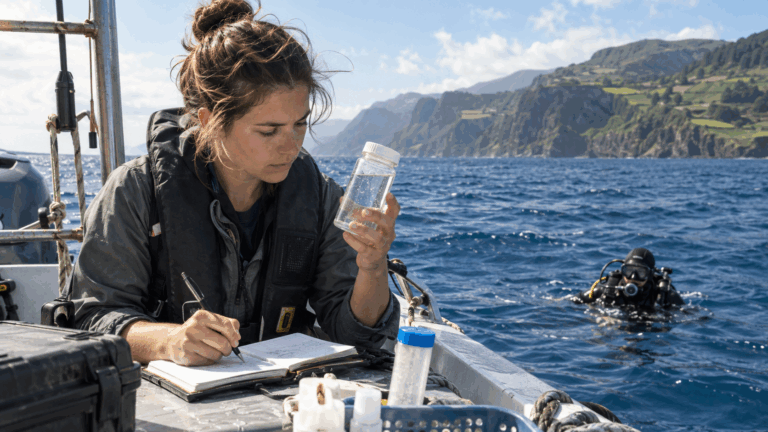
One of the most persistent myths about marine biology is that the job is ninety percent scuba diving. The reality is both more varied and, depending on your perspective, either more or less encouraging than that.
The short answer: no, scuba diving is not a universal requirement for a career in marine biology. A substantial proportion of marine scientists never put on a wetsuit professionally, and several of the field’s most important research areas, cetacean biology, oceanography, fisheries science, data modelling, and conservation policy, are conducted almost entirely above the waterline.
The more complete answer: it depends entirely on what you want to do. For certain career paths — coral reef ecology, underwater habitat monitoring, benthic surveys, marine conservation fieldwork — diving is not just useful but functionally indispensable. For others, it is irrelevant. Understanding which is which, early enough to plan accordingly, makes a genuine difference to how you build your skills and experience as a student.
This article explains where the line falls, what certifications actually matter for European students and researchers, and how to gain real underwater field experience if you want it.
When Is Scuba Diving Required in Marine Biology?
The answer depends on the environment you need to access. Marine biology is not one discipline — it is a broad term covering everything from microbial oceanography to shark population dynamics. The underwater component of the work varies accordingly.
Careers that commonly require diving
Some research and conservation roles are simply not practicable without being able to work underwater. These include:
Coral reef ecology and monitoring. Reef surveys — counting species, measuring coral cover, recording bleaching extent, collecting tissue samples — require researchers to be physically present on the reef. Remote sensing and towed underwater cameras can supplement this work, but they cannot replace it for the resolution of data required by most research programmes.
Benthic ecology. The study of seafloor communities, seagrass beds, rocky subtidal habitats, and soft sediment environments relies on direct observation and physical sampling at depth. Grab samplers and remotely operated vehicles (ROVs) handle some of this, but scientific diving remains the primary method for many survey types.
Underwater habitat restoration. Active coral restoration projects — coral gardening, substrate preparation, transplanting — are inherently hands-on and require sustained time underwater. The same applies to seagrass restoration and artificial reef installation.
Fish ecology and population surveys. Visual census methods (Underwater Visual Census, or UVC) are a cornerstone of reef fish research. The Belt Transect and Point Count methods that generate the majority of reef fish biodiversity data worldwide require trained divers with clipboards and slates.
Marine invasive species management. The manual removal of invasive species — lionfish in the Atlantic, Caulerpa seaweed in the Mediterranean — is fieldwork that happens underwater by definition.
Underwater photography and videography for scientific documentation. Research-grade documentation of subtidal habitats, animal behaviour, and ecological processes requires someone in the water with a camera.
Careers that generally do not require diving
This list is longer than most students expect:
Cetacean biology. Whale and dolphin research is overwhelmingly conducted from boats, using binoculars, hydrophones, photo-ID catalogues, acoustic monitoring equipment, and biopsy darts. Some projects use snorkelling for close observation in shallow water, but scuba diving is rarely useful — cetaceans are mobile, encounter durations are short, and the noise of scuba equipment is a confounding factor.
Physical and chemical oceanography. The study of ocean currents, temperature gradients, salinity, and biogeochemical cycles is instrument-based. CTD casts, Argo floats, moored sensors, and research vessel surveys generate the data. No dive required.
Fisheries science and management. Stock assessments, population modelling, bycatch analysis, and fisheries policy work are desk-based disciplines informed by vessel surveys and commercial landing data. The fieldwork component exists, but diving is rarely part of it.
Marine mammal and seabird ecology. Breeding surveys, population counts, telemetry studies, foraging ecology — all largely land-based or vessel-based work.
Environmental consulting and marine spatial planning. Data analysis, Environmental Impact Assessment (EIA) reporting, marine protected area design, and policy work are office disciplines with occasional vessel surveys.
Marine education and science communication. Teaching, outreach, and public engagement in the marine sector requires expertise in the subject, not necessarily time in the water.
Genetics, microbiology, and laboratory-based research. Many marine biologists spend most of their careers in a lab. Environmental DNA (eDNA) sampling, microbial diversity studies, physiological experiments — none of these require anyone to dive.
What Do Marine Biologists Do Underwater?
For those who do dive professionally, the underwater work is disciplined, methodical, and focused. It is not exploratory in the recreational sense — dive time is a limited and often expensive resource, and every minute underwater is directed toward a specific scientific objective.
The main tasks that marine biologist divers perform include:
Species identification and population counts. Using standardised transect and point count methods, researchers record species presence, abundance, and size distribution. This requires both diving competence and taxonomic knowledge — being able to identify reef fish or invertebrate species underwater, on a slate, within a defined time window, is a specific skill that takes practice to develop.
Ecological surveys. Measuring and recording the structural characteristics of habitats — coral cover percentages, substrate type, rugosity, invertebrate density — following established protocols (Reef Check, MERMAID, GCRMN methodologies) that allow data to be compared across sites and over time.
Coral reef and seagrass monitoring. Photoquadrats, line intercept transects, and belt transects provide quantitative data on the state of these habitats. The physical placement of the equipment and the recording of observations has to happen underwater, by a trained person.
Sample collection. Water samples from specific depths, tissue biopsies, sediment cores from the seafloor, invertebrate specimens — all require physical access to the collection point.
Underwater photography and video surveys. Photographic documentation of habitats and species, stereo-video systems for fish length estimation, and time-lapse monitoring of specific locations. Baited Remote Underwater Video (BRUV) systems can sometimes be deployed without a diver, but many require diver-assisted placement and retrieval.
Equipment maintenance and deployment. Many oceanographic instruments — current meters, temperature loggers, acoustic receivers for tagged fish — are fixed to the seafloor or to structures at depth and require diver access for installation, maintenance, and retrieval.
The common thread is that all of this is scientific work with a diving component, not diving with a scientific component. The research question comes first; the dive is the means of answering it.
What Scuba Certification Do Marine Biologists Need?
This depends on where you work and what you are working on. For European students, the certification landscape divides into two clear categories — recreational and scientific — and understanding the difference is important for anyone planning a career that involves diving.
Recreational scuba certifications
The main certification agencies operating in Europe — PADI, SSI, BSAC, and CMAS-affiliated national bodies — offer recreational scuba qualifications that are broadly equivalent and widely recognised.
For marine biology fieldwork, the typical progression is:
Open Water Diver (or equivalent) is the entry-level certification, typically completed in four to five days. It qualifies you to dive to 18 metres with a certified buddy. This is sufficient for a significant proportion of marine biology survey work, which takes place in relatively shallow reef environments.
Advanced Open Water Diver (or equivalent) extends the depth limit to 30 metres, introduces navigation and buoyancy skills, and adds specialist dives — deep, night, underwater photography — that are directly relevant to fieldwork. Most field research positions that require diving will expect at minimum this level of certification.
Rescue Diver is increasingly expected by research institutions and NGOs running field programmes. The course covers dive accident management, assisting distressed divers, and emergency response — skills that are particularly important when diving in remote locations with limited access to emergency services. It also demonstrates a level of commitment and competence that distinguishes applicants in a competitive field.
Divemaster certification is often recognised as the practical gateway to scientific diving roles. At this level, you have demonstrated significant logged dive experience, dive leadership ability, and comprehensive equipment and emergency knowledge. Some research institutions use it as an informal minimum for field positions that require extended underwater work.
Which agency you certify with matters less than most people think. All major recreational agencies — PADI, SSI, BSAC — are internationally recognised, and the CMAS star grading system provides a standard framework for comparing qualifications across European countries. A PADI Open Water diver and a BSAC Ocean Diver are considered equivalent in the eyes of virtually every research institution. PADI has the widest global network of dive centres, which is useful if you plan to dive across multiple countries. BSAC operates a club model that gives students access to regular organised dives, shared equipment, and a community of more experienced divers — which is a significant practical advantage when you are trying to build logged dives affordably.
Scientific diving certification in Europe
Scientific diving is a separate category with its own governance, distinct from recreational diving in both its purpose and its requirements.
In the UK, the relevant framework is the HSE (Health and Safety Executive) Scientific Diver qualification. This is an occupational standard that certifies divers to work underwater in a professional research capacity. It is not a recreational qualification — it is employer-provided training, and it is typically undertaken once you are affiliated with a research institution or university dive programme that holds HSE-approved status.
Across Europe, the equivalent standards are generally administered through CMAS (Confédération Mondiale des Activités Subaquatiques) and its national member organisations. Many European universities with marine research programmes run their own institutional scientific diving courses aligned with CMAS standards and national occupational health regulations.
The key distinctions between recreational and scientific certification are worth understanding clearly. Recreational certification qualifies you to dive for personal enjoyment within specified limits. Scientific diving certification qualifies you to collect data underwater as part of institutional research.
It involves more rigorous physical and medical requirements, significantly more training hours (typically 100 hours or more, including logged dives), and ongoing currency requirements — most programmes require a minimum number of scientific dives per year to maintain active status. An out-of-practice scientific diver is not a certified one.
For most students, the practical path is straightforward: obtain a recreational certification first — working through Open Water, Advanced, and Rescue Diver — and then pursue scientific diving training through a university programme or research institution once you are affiliated.
Open Water certification with a minimum number of logged dives is the standard prerequisite for entry into scientific diving courses. The recreational qualification is the foundation; the scientific one builds on it.
Can You Study Marine Biology Without Diving?
Yes, and this is an important point that gets lost in the mythology of the discipline.
Marine biology degrees at undergraduate level do not universally require scuba certification. Most programmes include elements of boat-based fieldwork, intertidal ecology, laboratory research, and data analysis that are entirely accessible to non-divers. Some offer diving as an elective or extracurricular activity rather than a core component.
At postgraduate level, the requirement depends entirely on your research focus. A PhD in cetacean acoustics, fisheries genetics, or physical oceanography will never require you to dive. A PhD in coral reef ecology almost certainly will.
The alternatives to diving that marine researchers use to access underwater data include:
Snorkelling. For shallow-water surveys — intertidal zones, seagrass beds, shallow reef to around 5 metres — mask and fins is sufficient for many data collection tasks. It is also how many marine biologists first become genuinely comfortable in the water.
Remotely Operated Vehicles (ROVs). ROVs are increasingly used for habitat surveys, species recording, and sample collection, particularly in deep-water environments beyond recreational diving limits. Skills in ROV operation and video analysis are increasingly valued across European research institutions.
Baited Remote Underwater Video (BRUV). Camera systems deployed on the seafloor and retrieved after a set period provide fish diversity and abundance data without any diver in the water. Analysis of the resulting video footage is an important component of many research programmes.
Acoustic monitoring. Hydrophones, echosounders, and acoustic telemetry systems produce datasets that require significant analytical expertise but no diving.
Environmental DNA (eDNA). Water samples collected at the surface or from known depths can be analysed for the genetic signatures of species present in that environment. A rapidly developing field that is expanding what is possible without direct underwater access.
The honest assessment is that these alternatives produce different kinds of data rather than equivalent data. Underwater visual surveys and physical sampling by trained divers remain irreplaceable for certain research questions. But there is no shortage of meaningful marine biology work for scientists who do not dive.
And crucially: you can always learn to dive later. Many marine biologists obtain their certification during postgraduate study, during a field internship, or early in their career when the specific requirements of their work make it necessary. It does not have to happen before you start.
Is scuba diving worth learning for a marine biology career?
If you have any interest in field-based marine biology — and most people who enter the discipline do — then yes, learning to dive is worth the investment of time and money. But the reasoning matters.
The professional advantages are real. Scuba certification broadens the range of positions you can apply for and the range of research questions you can contribute to. In a competitive jobs market, a candidate who can both design a survey methodology and execute it underwater is more useful to a research team than one who can only do one of those things. Dive experience also demonstrates a practical orientation and a genuine physical commitment to field science that many hiring managers read positively.
The limits are also real. Diving certification alone does not make someone a more employable marine biologist. The research skills, analytical competence, taxonomic knowledge, and scientific experience you bring to fieldwork matter far more than the certification card in your wallet. A diver who can identify fifty reef fish species and analyse a dataset in R is considerably more useful in most research contexts than a more experienced diver who cannot. Diving opens a door; it does not define what is behind it.
The physical reality deserves honest acknowledgment. Scuba diving requires reasonable physical fitness and the absence of certain medical conditions — cardiovascular issues, epilepsy, severe asthma, ear problems — that make equalisation or safe diving difficult. If diving is genuinely not possible for medical or personal reasons, the career paths that do not require it are substantial and scientifically important.
The most useful frame is this: treat diving as one skill in a broader toolkit, in the same category as boat handling, statistical analysis, GIS competence, or scientific writing. The more tools you have, the more versatile and valuable you are as a researcher. But tools are acquired in service of a scientific purpose, not as ends in themselves.
How to gain diving experience as a marine biology student
If you want to develop diving skills in a way that is directly relevant to marine fieldwork — rather than simply as a recreational activity — the path is more straightforward than it might appear.
Step 1: Obtain a recognised recreational certification.
Start with Open Water, then work toward Advanced Open Water. PADI is the most globally recognised agency and has the densest network of dive centres across Europe and in field destinations worldwide. BSAC is an excellent alternative, particularly if you are based in the UK, with the practical advantages of its club structure. Many European universities also have student dive clubs affiliated with their national CMAS member body, which can make early certification significantly cheaper.
Step 2: Build comfort and competence underwater before adding complexity.
The skill gap between a newly certified Open Water diver and a researcher who can operate efficiently underwater is significant. Managing buoyancy precisely enough not to disturb benthic habitats, writing on a slate without drifting off a transect, signalling a buddy while holding a camera and a torch — these things require automatic equipment competence that only comes from logging dives. Dive in different conditions, different environments, different visibility. Build the experience that frees your attention for the scientific task rather than the mechanical one.
Step 3: Get into supervised field environments.
This is where a structured marine biology internship becomes directly relevant. Participating in real research alongside experienced scientists — running actual transects, using the methodologies and equipment of real survey programmes — compresses the learning curve considerably. The difference between understanding reef survey methodology from a textbook and having run transects across ten dive sites is exactly the difference that separates candidates in application processes for research positions and postgraduate programmes.
Step 4: Progress toward scientific diving training when eligible.
Once you have the logged recreational experience and institutional affiliation — typically through a university programme, a research centre, or an NGO with an approved dive programme — scientific diving training formalises your competence into the occupational context that professional research positions require. In the UK, this means working toward HSE Scientific Diver status. Across the rest of Europe, the route runs through your university’s institutional dive programme or an equivalent CMAS-aligned structure.
Our Underwater Marine Conservation and Research Internship in Tenerife is designed for students at steps two and three of this progression. Working alongside marine biologists in the Canary Islands — one of the Atlantic’s most biodiverse marine environments and a globally significant location for marine conservation research — you will conduct real reef monitoring surveys, develop underwater research techniques under supervision, and build the logged field experience that distinguishes your application from others. Whether you are a newly certified diver wanting to transition from recreational to research diving, or a more experienced diver looking for structured scientific exposure, the programme provides the fieldwork context that classroom study cannot replicate.
Frequently Asked Questions
Is scuba certification required for a marine biology degree?
Not typically. Most undergraduate marine biology programmes in Europe do not require scuba certification as a condition of graduation, though many offer it as an elective or as part of specific field modules. At postgraduate level, requirements depend entirely on your research area — reef ecology and benthic research will expect diving competence, while many other specialisms will not. If diving experience is important to your intended research direction, check whether your target institution has its own scientific dive programme and what the entry requirements are.
What is the difference between recreational and scientific diving?
The primary distinction is purpose and governance. Recreational diving certifications — PADI, BSAC, SSI, CMAS-affiliated national qualifications — qualify you to dive for personal enjoyment within specified depth and environment limits. Scientific diving certifications qualify you to collect data underwater as part of institutional research, in a professional capacity. In the UK, the relevant occupational standard is the HSE Scientific Diver qualification.
Across Europe, equivalent frameworks are administered through CMAS national bodies and institutional university programmes. Scientific diving training requires significantly more logged hours than recreational certification, a formal institutional affiliation, and ongoing currency requirements — meaning you need to dive regularly to remain certified. Recreational certification is the standard prerequisite: you need to be able to dive safely before you can be trained to work underwater.
Can I learn to dive during a marine biology internship?
It depends on the structure of the programme. Some marine conservation and research internships include scuba instruction as part of the curriculum, allowing students to obtain their Open Water certification during the placement. Others require participants to arrive already certified and focus on developing research-specific techniques and logged fieldwork dives from that foundation. Our Tenerife internship programme accepts students at various certification levels — check the programme details for current entry requirements, or get in touch to discuss your specific situation.
Can I become a marine biologist if I cannot dive?
Yes. A significant portion of marine biology research — cetacean science, physical oceanography, fisheries management, environmental genetics, marine policy, science communication — does not require scuba diving at any stage. The discipline is broad enough to accommodate researchers who work entirely above the surface.
If diving is not possible for medical, personal, or other reasons, this does not preclude a meaningful and scientifically impactful career in marine biology. What it does limit is access to the specific research roles centred on underwater fieldwork — reef ecology, benthic surveys, coral restoration — where diving is genuinely essential rather than merely useful.
How many dives do I need before applying for research fieldwork positions?
There is no universal standard, but most research institutions and NGOs running field programmes expect to see at minimum 20 to 30 logged dives beyond your certification dives before accepting you as a field volunteer or intern diver. This threshold represents the point at which most divers have moved from managing their own comfort and safety to having enough spare cognitive capacity for the additional demands of fieldwork.
For positions requiring scientific diving certification, the bar is higher — institutional programmes typically require 50 to 100 or more logged dives as a practical prerequisite.
Does it matter which diving agency I certify with as a European student?
For most purposes, no. PADI, BSAC, SSI, and CMAS-affiliated national qualifications are all internationally recognised, and the CMAS star grading system provides a standard framework for comparing qualifications across European countries. A PADI Open Water diver and a BSAC Ocean Diver are considered equivalent by virtually every research institution.
PADI offers the widest global network of dive centres, which is useful for fieldwork in multiple countries. BSAC offers the practical advantages of its club structure — regular organised dives, access to shared equipment, and a community of experienced divers — which can make building logged dives significantly more affordable.
Your national CMAS member organisation may also offer certification routes that are particularly well-recognised within your country’s research institutions. The most important factor in any case is completing your training thoroughly, with a safety-focused instructor, and then logging the dives to build genuine competence.